 5 Page views
Published on Tue Aug 22 2023 | Metro Rail News Shahibabad Duhai Ghaziabad Guldhar Delhi-Meerut Regional Rapid Transit System (RRTS) Meerut South Station Delhi Muradnagar Modi Nagar South Modi Nagar North National Capital Region Transport Corporation (NCRTC) Haryana Rajasthan Uttar Pradesh RapidX (regional rapid transit) Services Hyderabad Telangana Savli Gujarat Under the Chairmanship of the Secretary Ministry of Urban Development (MoUD) National Capital Region Planning Board (NCRPB) Urban Mass Transit Company Limited Alwar Asia Infrastructure Investment Bank (AIIB) New Development Bank (NDB) Asian Development Bank (ADB) Commissioner for Metro Rail Safety (CMRS) Prime Minister Narendra Modi
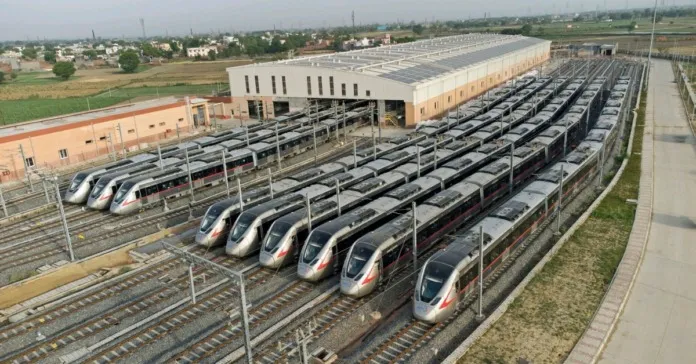
This month, RAPIDX, India’s first regional train service, is expected to begin operations on a 17-kilometre priority section linking Shahibabad and Duhai Depot. Sahibabad, Ghaziabad, Guldhar, Duhai, and the Duhai Depot are the five stations along the route. The stretch is part of the Delhi-Meerut Regional Rapid Transit System (RRTS) Project. Trains on the RRTS corridor have been designed to reach a top speed of 180 kmph. Along with the priority stretch, a 42-kilometre viaduct between Sahibabad and Meerut South Station has also been developed.
Following the priority segment, a 25-kilometre-long section encompassing Muradnagar, Modi Nagar South, Modi Nagar North, and Meerut South will be commissioned. The Delhi-Meerut Regional Rapid Transit System, development and construction works commenced in June 2019. The National Capital Region Transport Corporation (NCRTC), which is building the RRTS corridor, hopes to open the entire 82-kilometer-long Delhi-Ghaziabad-Meerut length to the public by 2025, along with Metro services in Meerut.
The trains are called RAPIDX because the acronym is easy to read and speak in a number of languages. The X in the name implies future-generation technology and the new-age mobility solution, in addition to speed and progress. It is also associated with youth, optimism, vigour and energy. The NCRTC, a joint venture operation of the Centre and the state governments of Delhi, Haryana, Rajasthan, and Uttar Pradesh, is developing the semi-high speed regional rail service across the National Capital Region (NCR).
The Making and the Features :
The RapidX trainset is an Electric multiple unit (EMU) train designed specifically for the country’s RapidX (regional rapid transit) services. The train had been designed in Hyderabad, Telangana, by the French rolling stock company Alstom, and manufactured at Savli, Gujarat. The train has an aerodynamic design that decreases drag when it travels and advances at the top operational speed of 160 km/h. Though, the design speed of the RapidX is 180 Km/Hr.
Different From Metro & Conventional Railway:
RRTS differs from metro in the sense that it caters to passengers who want to travel a longer distance with fewer stops and at a faster speed. RRTS differs from the conventional railway in a fact that it shall enable dependable, frequent, point-to-point regional transport at high speeds over a designated path. RRTS is a new, dedicated, high-speed, high-capacity, comfortable commuter service that connects regional nodes in the National Capital Region.
India’s Pride: The Make in India Initiative:
Under the Chairmanship of the Secretary Ministry of Urban Development (MoUD), the Planning Commission established a Task Force in 2005 to build a multi-modal transit system for the Delhi National Capital Region (NCR). This was included in the NCR 2032 Integrated Transport Plan, with a focus on Regional Rapid Transit System (RRTS) connections between regional hubs. The Task Force identified eight corridors and prioritised three corridors for implementation: Delhi-Meerut, Delhi-Panipat, and Delhi-Alwar. The National Capital Region Planning Board (NCRPB) appointed M/s. Delhi Integrated Multi-Modal Transit System for Delhi-Meerut and Delhi-Panipat, and M/s. Urban Mass Transit Company Limited for Delhi-Alwar, to conduct feasibility studies and prepare the Detailed Project Report in March 2010.
There was a need for a new semi-high-speed trainset envisaged, specifically designed for semi-high-speed regional rail travel when the RapidX service was conceived. The train sets were intended to be locally produced in compliance with the Make in India programme after the NCRTC opened tenders for the same in 2019. In early 2020, the NCRTC finalised the procurement of train sets, which were to be produced in Savli by Bombardier Transportation. In accordance with the Make in India policy, the tender was finalised and settled with the condition of trains to have fifty percent of local components as opposed to the original requirement of 75 percent. The train’s design was revealed to the public later in the year. The train’s stainless-steel body has been designed and engineered to reach a top speed of 180 km/h.
Exterior:
Interior:
Other Features:
System Specifications:
Conclusion:
The RAPIDX, India’s first regional train service, will begin operations on the priority segment soon. Sahibabad, Ghaziabad, Guldhar, Duhai, and the Duhai Depot are the five stations along the route. Work on all these stations have almost been completed and are nearly ready for operations. This section is a part of the Delhi-Meerut Regional Rapid Transit System (RRTS). In a recent development by NCRTC (National Capital Region Transport Corporation), it has been stated that safety approvals from the Commissioner for Metro Rail Safety (CMRS) have been received, and the project is expected to be inaugurated by Prime Minister Narendra Modi in the coming days.

Delhi–Siliguri Bullet Train Announced: Via Lucknow, Varanasi And Patna, Travel Time To Drop From 20 Hours To 6

Delhi to Jewar Airport in 21 minutes: New RRTS corridor to link Noida Airport with Varanasi bullet train
L-G directs DDA to chart out plan to develop Dwarka into an international investment hub
New 10-Lane Delhi-Jewar Corridor Planned Ahead Of Noida Airport Launch
Now homeowners can file online complaint against builders for illegal transfer charges in Uttar Pradesh; Step-by-step guide on how to do it