 328 Page views
Published on Mon Dec 01 2025 | The New Indian Express New Delhi NCR Delhi Ministry Of Road Transportation And Highways (morth) Haryana Uttar Pradesh Rajasthan Punjab Uttarakhand Eastern Peripheral Expressway (EPE)\ Ghaziabad Noida Palwal Dhaula Kuan Gurugram Gurgaon
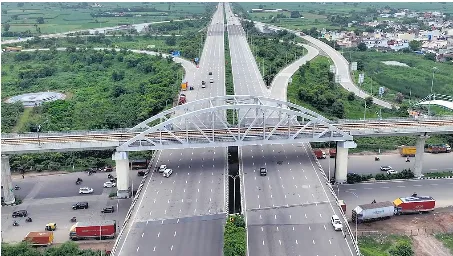
NEW DELHI: Something is changing in and around the capital. It is fast becoming the most dominant flower around which a bouquet of massive, state-of-the-art highways is being created in the NCR.
Once completed, it will turn the city into an island, which is connected to the national grid of roads while maintaining its infrastructural and access autonomy.
At the heart of this transformation lies one of the largest road infrastructure overhauls in the country, which is aimed at easing chronic traffic congestion in and around Delhi. The Ministry of Road Transport and Highways (MoRTH), as the anchor ministry behind the overhaul, is executing a multilayered strategy involving completed, ongoing, and upcoming national highway projects designed to transform mobility in the region.
It is a massive 2,320 km plan, involving Haryana, Uttar Pradesh, Rajasthan, Punjab, Uttarakhand, and Jammu and Kashmir. The MoRTH data shows that it has already achieved 69 per cent completion.
A need for scale
The MoRTH ministry says the government has already completed planned road development work spanning 1,578 km, which were delivered at a cost of Rs 63,934 crore, while the projects that have been awarded to implementing agencies and are in various stages of completion cover 594 km, worth Rs 34,589 crore.
Moreover, the government is planning to execute projects for another 128 km, which will cost around Rs 23,850 crore.
At Delhi Dialogues, Union Minister of State for the Ministry of Road Transport and Highways and Ministry of Corporate Affairs Harsh Malhotra said that the capital region witnessed unprecedented highway development in the past decade, whose momentum would continue to grow with several more key corridors progressing toward completion.
He says, “The ministry has been consistently working to make the national capital and its adjoining areas congestion free. A proper plan has been chalked out, and it is being executed accordingly. Lots of projects have been executed over a decade, and many more are in the pipeline. In the near future, the entire region will have an augmented network of road infrastructure, which will help to remove traffic deadlocks.”
Malhotra said the success of Eastern Peripheral Expressway (EPE) among the completed projects at the top of the list. This 135 km project was one of the first completed decongestion plans for the capital. Conceptualised at an investment of Rs 12,000 crore, it keeps around 95,000 passenger cars away from the Delhi borders every day.
It picks traffic from key urban nodes in the NCR, like Kundli, Ghaziabad, Dadri, Greater Noida, and Palwal, and connects them to the Delhi-Chandigarh highway away from the national capital in Haryana. Along with the Western Peripheral Expressway, it forms a ring of mobility that considerably eases congestion within Delhi’s core.
West side
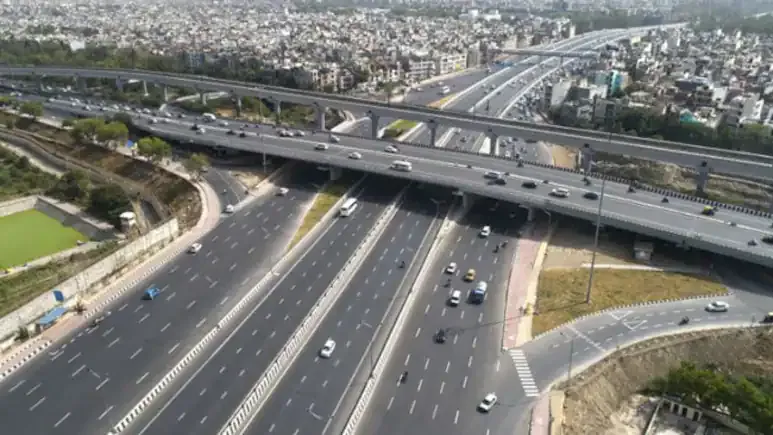
Within the city, the Centre has created a decongestion plan by markedly improving existing roads through widening, constructing flyovers and grade separators, creating signal-free options for long stretches, and circular U-turns. One such stretch on the western side of Delhi is between Dhaula Kuan and Gurugram, which is one of the most critical arterial connections for Delhi and is vital to the economy of both the cities as it connects the capital to a major IT and outsourcing hub. Developed at a cost of Rs 373 crore, this stretch is a lifeline for traffic destined for Jaipur, Dwarka, Gurugram, and the IGI Airport in either direction.
This stretch relieves drivers’ pain at choke points such as Hero Honda Chowk, Rajiv Chowk, Signature Tower, and IFFCO Chowk along NH 48. The NH 48 bypass road of the Delhi-Gurugram Expressway is designed to improve connectivity between IGI Airport and UER-II, Gurugram and Dwarka.
The proposed 5 km road tunnel starting from Dwarka Motorway to Nelson Mandela Marg, Vasant Kunj, aims to link Central and East Delhi with the Delhi–Katra Motorway (NE 5), NH 44, NH 10, the Delhi-Jaipur Highway (NH 48) and the Delhi–Dehradun Motorway (NH 709B) via UER II and the Dwarka Motorway.
Northern heights
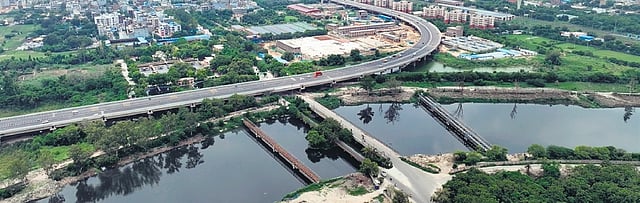
There is a renewed push to upgrade Delhi’s northern national highway, NH 44, which was earlier called NH 1 to global standards. Through this highway, the travel between Delhi and Haryana has been transformed with the completion of the 70 km Delhi-Panipat corridor, which has been built at a cost of Rs 2,205 crore. Its 11 flyovers have a combined elevated length of 24 km. Its upgraded eight-lane stretch reduces travel time to Panipat by almost an hour from city centres.
The 76-km Urban Extension Road II (UER II), conceived under the Delhi Master Plan 2021 is built at a cost of Rs 8,000 crore. With 95 per cent work done already, it is slated to be the Capital’s third Ring Road. UER II was later notified as a national highway and executed across five packages.Once operational, the corridor will offer faster connectivity between Chandigarh and Gurugram or IGI Airport decongesting underdeveloped belts such as Najafgarh, Mundka, Karala, Alipur and Bawana.
Set to become a key motorway link connecting UER-II, Dwarka Motorway and the Delhi-Mumbai Motorway, the proposed extension of the Delhi-Amritsar-Katra Motorway (NE 5) from KMPE till Urban Extension Road II (NH 344M) and Haryana is a 20 km highway, estimated to cost Rs 4,000 crore.
The upcoming extension of Urban Extension Road II (NH 344M) near Alipur till Delhi-Dehradun Expressway (NH 709B) near Tronica City will act as bypass to NH 44/Outer/Inner Ring Road.
Rising in the east
Another significant highway that leaves the city and takes crowds along is on the eastern side that has changed people’s impression of what lay across the Yamuna both within the city as well as beyond its borders. The fully built Akshardham-EPE segment of the soon-to-be-commissioned Delhi-Dehradun Expressway has added another vital, and much needed, layer of connectivity to the traffic going towards Noida, Ghaziabad, and to the Uttarakhand hills. This saves travellers crucial 25 kilometres from the earlier routes, which translates into about an hour of saved time in the NCR .
Put together, these projects are not just about the roads; they reflect a strategic reshaping of mobility in northern India. Reducing the travel time between Delhi and Meerut to approximately 45 minutes compared to the previous 2.5 hours, the expressway (NE 3) passes through key areas including Akshardham, Ghazipur, Ghaziabad, Dasna, Pilakhua, Hapur. The project is 92 per cent complete, say officials.
The 65 km Eastern Extension of Urban Extension Road II from the Delhi-Dehradun Motorway to Noida via the Ghaziabad/Faridabad project, estimated at Rs 7,500 crore, will link several major corridors,
including the Delhi-Dehradun Motorway (NH 709B), the Delhi-Meerut Motorway (NE 03), the Noida-Greater Noida Motorway, the DND-Faridabad highway and the Yamuna Motorway.

Delhi–Siliguri Bullet Train Announced: Via Lucknow, Varanasi And Patna, Travel Time To Drop From 20 Hours To 6

Delhi to Jewar Airport in 21 minutes: New RRTS corridor to link Noida Airport with Varanasi bullet train
L-G directs DDA to chart out plan to develop Dwarka into an international investment hub
New 10-Lane Delhi-Jewar Corridor Planned Ahead Of Noida Airport Launch

Now homeowners can file online complaint against builders for illegal transfer charges in Uttar Pradesh; Step-by-step guide on how to do it